
It depends on the need or purpose you are going to use it for. If you are just starting out, a low-power beginner’s bow is recommended. If it’s for target shooting, you may choose an Olympic bow, a traditional bow, or a precision compound bow. If it’s for hunting, a short axle-to-axle compound bow, less than 35 inches, is ideal.
Additionally, it also depends on your personal taste or preference.
The draw length can be measured by extending your arms in a “T” shape and measuring from fingertip to fingertip. Once measured, divide by 2.5 and then convert to inches (divide by 2.54). The result is your approximate draw length. This measurement may influence the choice of bow, especially for beginner and Olympic bows.
The draw weight is determined based on the archer’s experience, although body composition also plays a role: 15 pounds for children, 18-24 pounds for beginners. Once you get started, 25-26 pounds are typically suitable. For intermediate experience, 30-35 pounds is common, and for experts, it ranges from 50-70 pounds, depending on the bow.
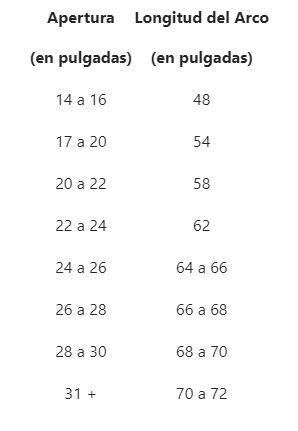
For beginner bows and Olympic bows with detachable limbs, there is a comparison chart for archer draw length / bow length.
For traditional bows, they are typically designed for a draw length of between 26 and 30 or 31 inches, depending on the model. The longer the draw length, the more comfortable a longer bow will feel, and vice versa, with the average being a 28-inch draw length for the archer.
For compound bows, the draw length is adjustable, but you must first check if the compound bow accommodates your draw length. This is usually specified in the bow’s specifications.
Each arrow model has a stiffness chart that is measured in relation to the arrow length (draw length) and the draw weight used. In the specifications of each arrow, a link to the specific stiffness chart for that model and type of arrow is provided.
Each arrow model has a stiffness chart that is measured in relation to the arrow length (draw length) and the draw weight used. In the specifications of each arrow, a link to the specific stiffness chart for that model and type of arrow is provided.
Yes. You need to have a permit or license that at least allows the ownership or transportation of the bow (as a weapon). This minimum permit, which allows you to own and transport a bow, can be acquired in-store. If you are a member of a federation, the federation card serves this purpose.
Yes. To practice archery, you must have completed an archery course and be a member of a federation. If you are a bowhunter, the procedure is different.
With the proper permits and by following the rules and laws of the community and area, yes. It is best to check with the relevant Hunting Federation of the autonomous community where you plan to hunt.
Normally, bows are not “ready to shoot”. They will require some minimal adjustments, such as for traditional or beginner bows (nock placement, attaching arrow rests or padding…), or compound bows, which will always require custom adjustments in a workshop for the archer who will shoot with it.
These services are typically offered by archery shops or by experienced archers who are members of a club.