
Strings for archery are one of the most important parts of the bow, necessary for transmitting the power from the limbs to the arrow. There are many types of strings made from different materials for different uses and bows. They can be thicker or thinner, which affects their speed, elasticity, and stretchability.
Strings are typically made from durable and high-performance materials specifically designed for archery.
You can find specific strings for all types of bows, whether traditional recurves, longbows, Olympic bows, pulley bows, or even crossbows.
Types of Strings Used in Archery
- Endless or Continuous String: The endless or continuous string is made by winding a continuous thread from one end to the other of the bow frame, repeating the process until the desired number of strands is reached. This results in a string without loose ends. Once finished, the string is wrapped at both ends and finally in the middle. This type is used in almost all types of bows, but most commonly in beginner recurves, barebows, Olympic bows, and pulley bows, as well as crossbows.
- Flemish or Braided String: As the name suggests, these strings are braided and are not continuous, but instead, the ends are interwoven to form loops. These strings are mainly used in traditional bows and longbows.
Common Materials for Archery Strings
Dacron: Dacron strings are made from a quality material but stretch upon release, absorbing part of the kinetic energy from the shot. These strings are ideal for beginner bows, wooden bows, and other bows that cannot handle harder or higher-performance strings.
Fast Flight: Fast Flight strings are made from a hard material that allows for much higher arrow speeds due to their lack of elasticity. These are commonly used in Olympic bows and other high-performance bows with tip protection for that purpose.
DynaFlight: DynaFlight strings are similar to Fast Flight but have greater rigidity, resulting in a harder shot.
8125: The 8125 string is another high-performance option for compound bows.
452x: The 452x string is commonly used for pulley bows.
Number of Strands and Thickness of Archery Strings
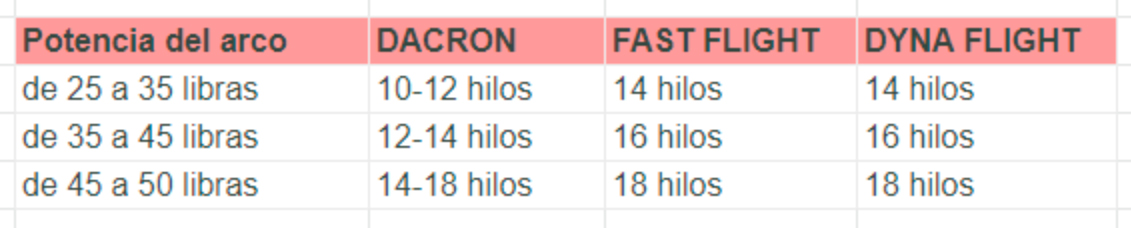
The recommended number of strands for each bow’s draw weight and type can vary. While there is a general string (except for pulley bows), strings are usually specific to each bow. For example, a thicker string will be slower but more suitable for higher-power bows. Slower strings do not stress the bow as much, absorb vibrations better, and provide a more stable shot, whereas thinner strings are faster but tend to absorb more vibration into the bow. These are just a few of the factors to consider when selecting a string. Generally, a good balance between the string’s characteristics should be sought based on your bow, arrows, and other specific needs.
Recommendation Table:
 General Features of Archery Strings:
 General Features of Archery Strings:
- Elasticity: Elastic strings, like Dacron, absorb part of the energy generated from the shot due to their elasticity. In contrast, stiffer strings transmit most of the energy to the bow, making the shot more abrupt and potentially damaging the bow or limbs if the bow is not designed for such strings.
- Weight: The weight of the string affects its speed. A heavier string will be smoother to shoot but slower, and the arrow will have less speed when released.
- Durability: Durability refers to two factors: break resistance and abrasion resistance. Depending on the string material, it will have different levels of resistance to each.
- Material: Each string manufacturer uses different materials, ranging from polyester to spectra or other modern formulas with varying qualities and characteristics.
Maintenance of Bowstrings
String maintenance is currently done with either natural or synthetic wax, which hydrates the fibers and helps keep the string elastic, ensuring longer durability and preventing it from breaking. Poor maintenance significantly reduces the lifespan of the string due to fiber degradation caused by continuous friction, leading to thread breakage.
Materials for Archery Strings (BCY Brand)
- BCY X99 STRING
Made with 80% SK99 Highest Quality Dyneema and 20% Vectran.
All the characteristics and performance of BCY-X. Compared to BCY-X, the smaller diameter of X-99 means more strands are needed to make a completed bowstring (+2/4). It is good for compound and recurve bows. Available in solid colors.
No creep
Good arrow speed
High abrasion resistance
Recommended strands: 26-28 for compound bows
- BCY MERCURY STRING
Made with 100% first-quality Dyneema fiber (SK99) with low creep and a smaller diameter for a smoother and rounder string. Greater strength and high durability.
Recommended strands: 32-34 for compound, 2 or 4 less for recurve
- BCY FORMULA 8125 STRING
Made from 100% SK75 Dyneema®. Maximum speed and durability; favored by some compound shooters, particularly for 3D archery. Also a great choice for Olympic recurve archers worldwide.
Recommended strands: 18-22
- BCY DYNAFLIGHT 97 STRING
Original Dyneema® high-strength string made from 100% SK75; very durable with low creep. Used for crossbows, compound bows, recurves, and beginner or recreational bows.
Recommended strands: 14-16
- BCY 652 SPECTRA STRING
Spectra bowstring, similar to original Fast Flight, remains the choice of many recurve shooters worldwide.
Recommended strands: 18-22
- BCY 452X STRING
Made from 67% SK75 Dyneema® and 33% Vectran. Good arrow speed. No creep; fully stable.
Recommended strands: 20-24 for compound bows
- BCY DACRON B-55 STRING
Made from 100% polyester, similar to Dacron but with greater durability and very little stretch. Primarily used for recurve bows but also in older compound crossbows and traditional bows without reinforced tips.
Recommended strands: 12-16 for recurve bows
- BCY 450 PLUS STRING
Original Dyneema® / Vectran blend. No creep and stable. A good option for compound cables.
Recommended strands: 12
Materials for Bowstring Serving (BCY Brand)
- BCY HALO SERVING
Made from 100% Spectra, tightly braided, ideal for end or center servings.
- BCY POWERGRIP SERVING
A new blend of tightly braided Spectra and nylon thread. Strong, durable, resin-coated, and grips well.
- SPECTRA 008 SERVING THREAD
Small diameter fits well in all string grooves and pulleys. Strong and durable, grips well.
Diameter: .008″
- 3D BRAIDED SERVING THREAD
Small diameter available in Dyneema® or Spectra three-layer braided material. Highly recommended for final servings. Servings should be tight but flexible.
Break resistance: approx. 60 pounds
Diameter: .016″
- BCY 62 SERVING THREAD
Original Spectra/Dyneema® and polyester blend. Grips well. Black/white color.
- BCY 62XS SERVING THREAD
20% stronger and more durable thanks to a higher percentage of Spectra or Dyneema®. Grips well.
BCY 2X SERVING THREAD
100% Dyneema® or Spectra with small diameter. Suitable for compound bows requiring abrasion protection for cables.
Break resistance: approx. 50 pounds
Diameter: .015″
- BCY 2S SERVING THREAD
BCY 2S with .018″ thickness is recommended for end servings. A two-layer braided Spectra thread, strong and durable. Break resistance: approx. 60 pounds.
- BCY POLYGRIP SERVING THREAD
Made from 100% polyester; grips very well.
Diameter: .020” for ends and .025″ for center servings
- BCY NYLON 400 SERVING THREAD
Ideal for end servings made from multifilament nylon 400
Also used for nock points and peeps.
Break resistance: approx. 30 lbs.
Diameter: .020″
- BCY NYLON 350 SERVING THREAD
Small diameter end servings. Also used in FITA bows.
Break resistance: approx. 15 lbs.
Diameter: .015″
- BCY NOCK POINT AND PEEP TYING THREAD
Made from 100% high-tenacity nylon to improve abrasion resistance. Won’t unravel when cut. High strength, weather-resistant.
Diameter: .020″
For more information on these materials, you can visit the manufacturer’s official page:
- http://www.bcyfibers.com/
- https://brownellarchery.com/
All recommendations are approximate and should always be tested, as everything depends on the type of bow, its draw weight, construction materials, and additional accessories.