**Brief guide to choosing the right arrows for our bow and the discipline we practice, whether it’s target archery or hunting. We cover important aspects such as arrow stiffness, the correct length, as well as safety rules and how to inspect an arrow before shooting.**
How to choose arrows for target archery (recurve or compound)
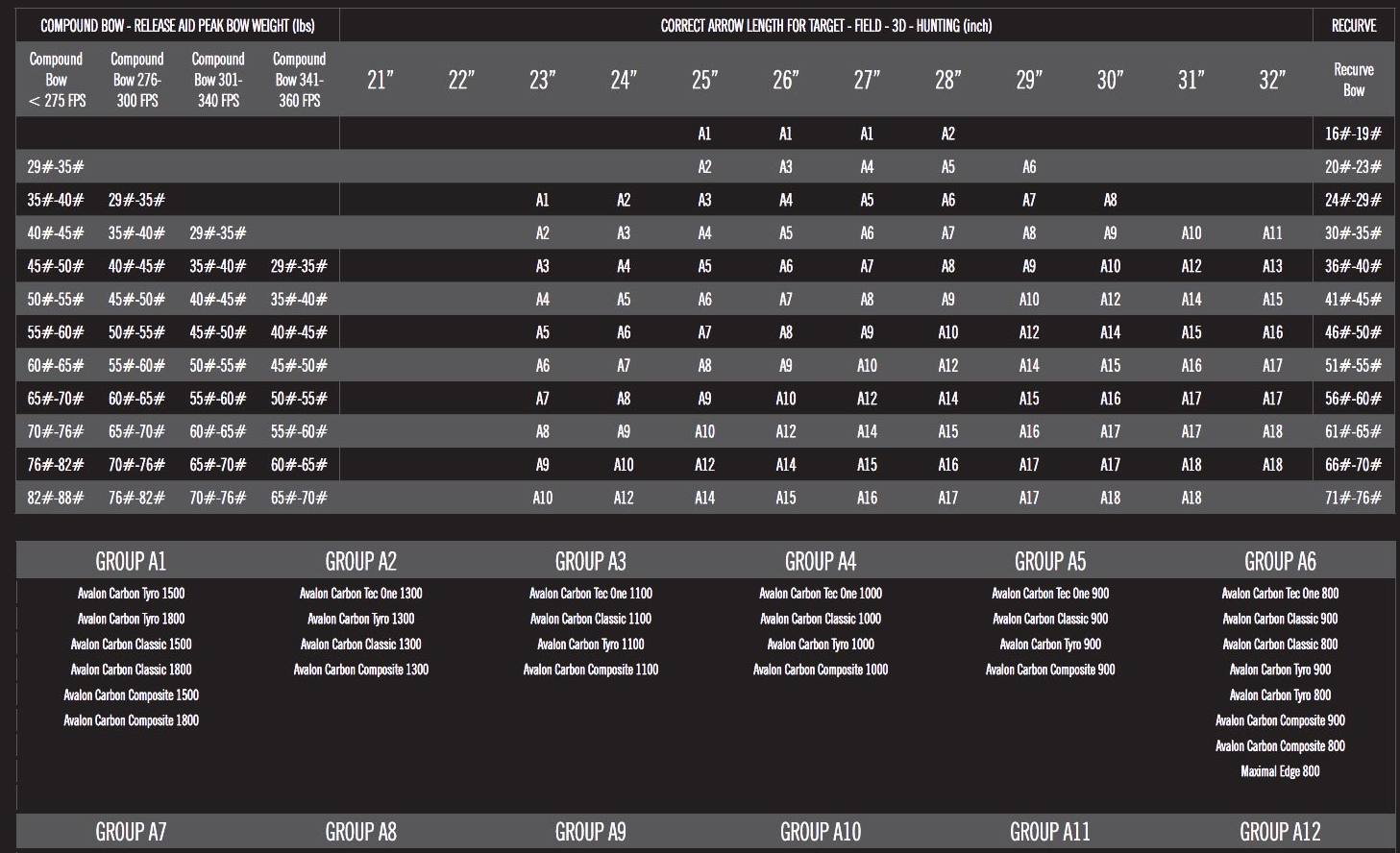
First, we need to check the specific stiffness or spine chart provided by each brand or manufacturer for their arrow models. Knowing the bow’s draw weight in pounds and the length of our arrow, the chart will indicate the stiffness value recommended by the manufacturer.
Example chart for different carbon arrow models from Avalon Archery. On the left, we can see the values for compound bows with their speed in FPS, and on the right, the values for recurve bows with their draw weight, with the center table cross-referencing bow power with arrow length.
Additionally, depending on the manufacturer, there may be more advanced interactive charts available on their websites where we can input data like tip weight, insert, fletching, nock, etc.
It is important to ensure that each arrow model is suitable for the bow we are using. If they are not the right fit, the arrow’s performance and integrity could be seriously affected, compromising the safety of the archer.
Correct arrow length for target archery (recurve or compound)
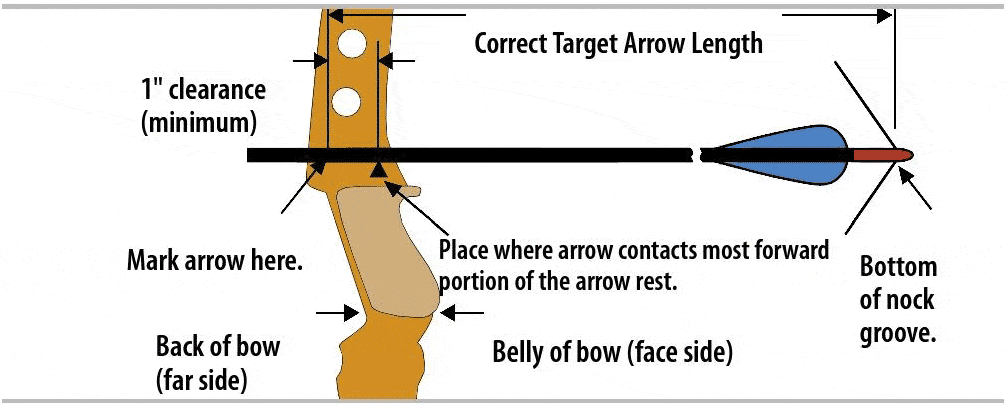
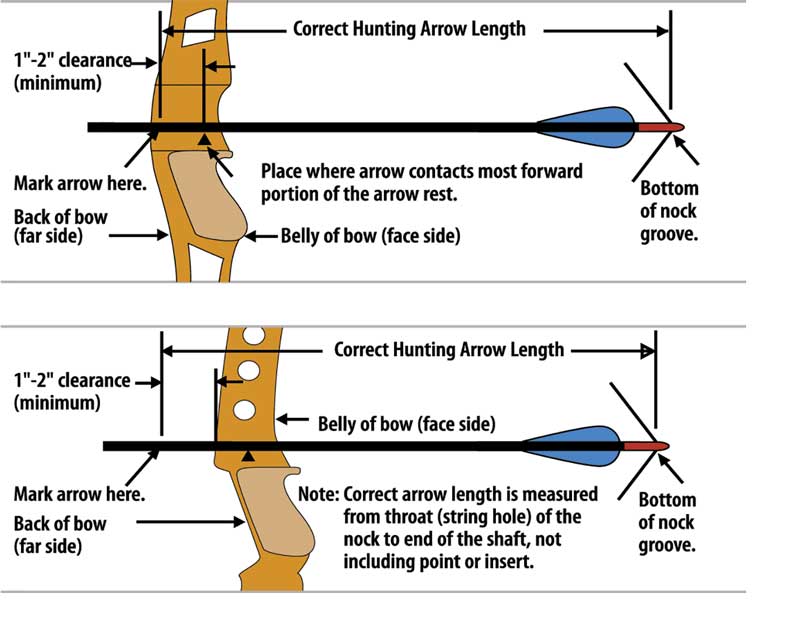
The arrow length is measured from the nock groove of the arrow where the string sits to the end of the shaft, excluding the tip.
Typically, when starting in archery, arrows are not cut to the individual archer’s draw length but are left as is until the archer has properly settled into their shooting stance.
Once the archer has practiced enough to define their draw length while drawing the bow, the arrows can then be cut to size.
For target archery, the length is measured from the point where it rests on the arrow rest, plus a minimum of 1 inch. This measurement is the archer’s draw length + 1 inch. This is the length you need to buy from the spine or stiffness chart for each arrow, along with the bow’s power/speed values.
How to choose arrows for hunting (recurve or compound)
For hunting bows, since the arrows have very sharp hunting tips, a longer arrow is recommended, at least 1 or 2 inches longer. If the arrow were too short, the hunting tip might cause discomfort or injury to the hand or bow.
In this case, the arrow length needs to be compared with the bow’s draw weight and speed in FPS (for compound bows) to find the stiffness recommended by the manufacturer. It is important to make sure the arrows are suitable for our bow.
Safety rules and proper arrow inspection
Arrows, when hitting a soft target or another hard object, can become weakened, lose integrity, break, or crack. This is especially true when they strike something hard.
To properly inspect each arrow before shooting, we should follow these steps:
Perform a complete inspection of the bow to ensure that all components are tightly secured, the bow is undamaged, and it is fully adjusted (to size) and in perfect condition. Make sure the arrow length is correct for the bow’s draw length and adjustment. NEVER shoot with an unadjusted or damaged bow.
Arrows can suffer damage to their structure or components, either from use, handling, or transport. It is essential to check the integrity of each arrow before use to avoid accidents. Perform a thorough inspection of the arrow, rotating it between your fingers to detect any nicks, cracks, dents, or other imperfections or damage. If any damage or imperfection is found, discard the arrow and do not shoot with it. NEVER shoot with a damaged arrow, and ALWAYS inspect each arrow carefully before shooting.
As an additional TEST to inspect our carbon arrows, we can do the following: Place one hand on each end of the arrow (tip and nock) and flex the arrow tube about 2.5 to 5 cm several times while rotating it along its axis to ensure all directions are checked. If you hear a “CRACK” or crunching sound, discard the arrow.
Another necessary TEST is to twist the arrow from each end along its axis. If it returns to its position slowly or is easily twisted, the arrow’s integrity is compromised, and it should also be discarded.
If we need to cut a carbon arrow to size, it should be done with specific archery workshop tools using a circular saw designed for cutting arrows.

 Safety rules and proper arrow inspection